

Explainability#
prophys.explain attributes predictions of a surrogate to its inputs, and
risk statistics of a whole model to its random inputs. Coalition arithmetic
(exact Shapley values, interaction indices, the KernelSHAP solve, TreeSHAP)
runs in the optimized native kernels.
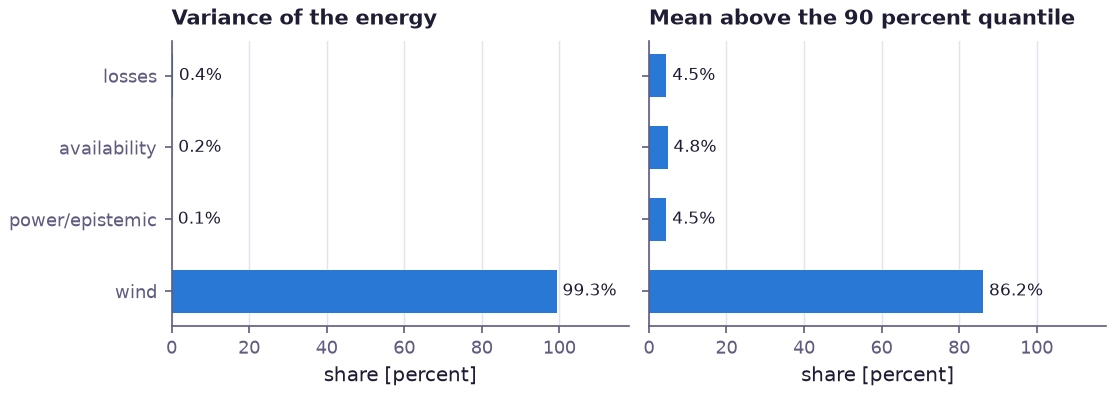
Energy yield of a turbine whose power curve is a learned surrogate. The variance is almost entirely wind, but the tail average above the 90 percent quantile owes a visible share to availability, losses and to what the power curve surrogate does not know.
Local explanations#
Every method accepts a surrogate, a tree ensemble, or any function of an
[N, d] array, and returns ShapValues with
attributions values [N, K, d] and the reference value base so that
base + values.sum(-1) reproduces each prediction.
Function |
Method |
When to use |
|---|---|---|
|
Exact path dependent TreeSHAP (Lundberg et al. 2020). |
Tree ensembles, including imported XGBoost and LightGBM models. |
|
Exact interventional Shapley values over all coalitions, with pairwise Shapley interaction indices. |
Up to sixteen inputs. |
|
KernelSHAP with paired coalitions from the Shapley kernel. Exact when the budget covers every coalition. |
Many inputs, any model. |
|
Integrated gradients averaged over background baselines, an approximation of interventional Shapley values. |
Differentiable models with many inputs. |
|
Path integral of the gradient, complete up to quadrature error. |
A single meaningful baseline. |
from prophys import explain

sv = explain.tree_shap(trees, records[:200])
sv.importance()                      # mean absolute attribution per input
ex = explain.shapley_values(power, x[:10], x_background)
ex.interactions[:, 0]                # pairwise interaction indices
System level attribution#
shapley_effects() attributes a statistic of a model
attribute to the model’s random variables. The value of a coalition J is
a statistic of the conditional mean E[Y | X_J], estimated by nested
Monte Carlo on the compiled graph (outer draws of X_J, inner draws of the
rest).
|
Value of a coalition |
Meaning of the attribution |
|---|---|---|
|
|
Shapley effects (Owen 2014, Song et al. 2016). They sum to the variance, split it fairly under dependence, and equal Sobol indices for additive models. |
|
Tail average of |
How much each input contributes to the tail average exceeding the mean. A tail risk attribution. |
|
Variance of the indicator |
Which inputs drive the exceedance of a limit. |
r = explain.shapley_effects(model, "energy", statistic="cvar", level=0.9,
                            n_outer=2000, n_inner=32)
print(r)            # players, values and shares
r.interactions      # pairwise interaction indices of the same game
groups maps a player name to several random variables, for inputs that
are dependent (a copula) and should be attributed together. Every coalition
is evaluated exactly for up to twelve players. The epistemic random variable
of a surrogate (s.epistemic) is a player like any physical input, so the
share of risk owed to the surrogate’s ignorance is reported next to the
physics.
Accuracy#
The inner sample size sets the precision of the conditional means. For the
variance the resulting bias is removed. For the tail average it is not, and
players with a small true share are overstated when n_inner is small, so
use at least 32 inner draws for tail attribution.